
8. 10. 2026
How to Store and Display Minerals Properly – From a Small Box to a Display Cabinet
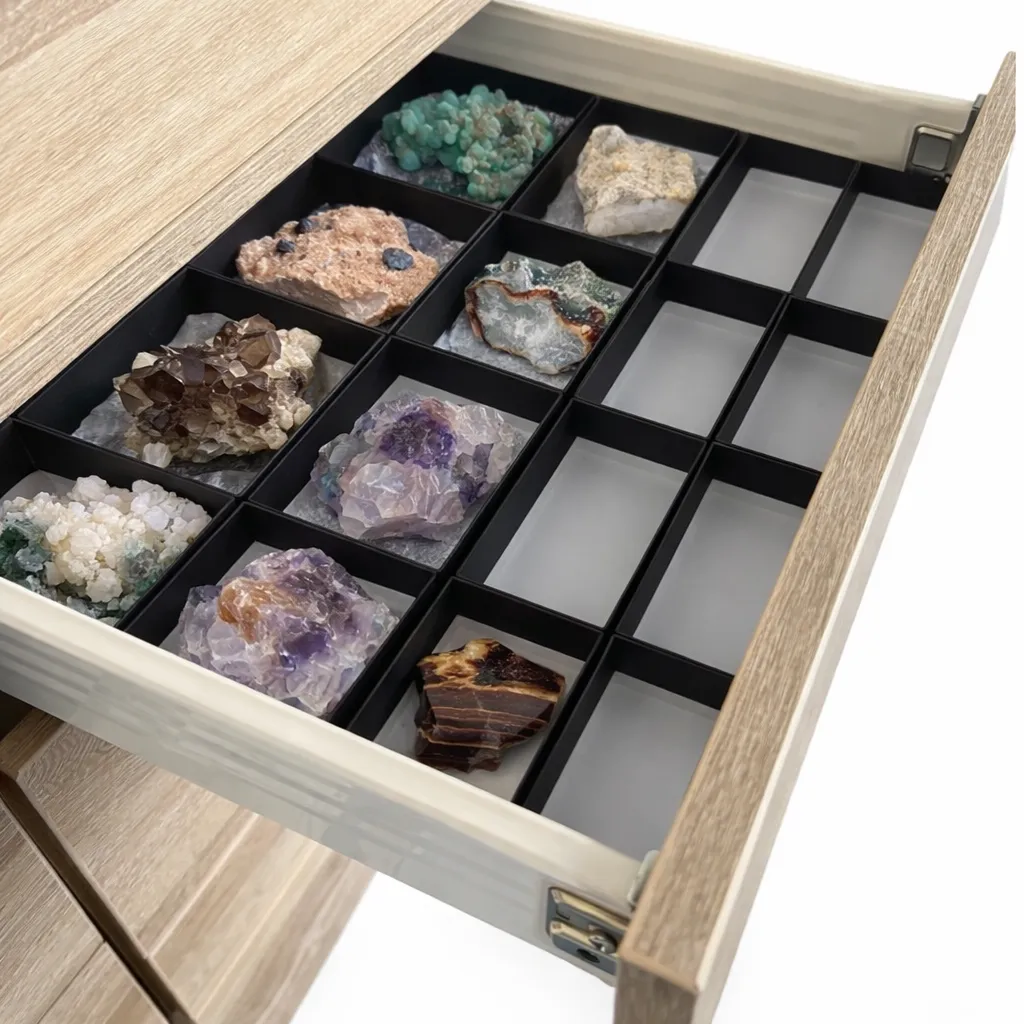
Here are some practical tips on how to store, organise and display your mineral collection.
1. Small Minerals – A Box as the Basis of Protection
For smaller minerals, crystals, fossils and other collectable specimens, sturdy paper boxes provide a practical storage solution.
They help protect specimens from dust, damage and contact with other minerals, while also creating a neat and visually consistent collection.
For additional protection, boxes can be fitted with suitable inserts. Foam and other soft inserts help keep specimens securely in place and reduce movement during handling or transport.
Our tip:
For dark or brightly coloured minerals, a light background can provide an attractive contrast. Light-coloured crystals, on the other hand, often stand out beautifully against a black insert.
Boxes can also be customised with your logo, the name of the mineral or other information printed on the lid, making them particularly suitable for mineral dealers, museums, mineralogical societies and gift collections.
2. Flat Boxes – When Your Collection Starts to Grow
As the number of specimens in your collection increases, an important question arises: how can you keep everything organised and easy to find?
A practical solution is a flat box, which can hold several individual boxes containing mineral specimens.
Each specimen remains separated and protected while allowing an entire group of minerals to be stored together.
Flat boxes are particularly suitable for:
- systematic mineral collections,
- organising minerals by locality or type,
- transporting specimens,
- preparing collections for mineral fairs and exhibitions,
- storing larger quantities of specimens.
By combining different box sizes, the available space inside a flat box can be used efficiently even when storing specimens of different dimensions.
3. Display Stands Allow Minerals to Truly Stand Out
Some minerals deserve to be displayed individually.
An interesting crystal, fossil or exceptional collector's specimen can look completely different when presented on a carefully chosen display stand rather than simply placed on a shelf.
A stand visually separates the specimen from its surroundings and draws attention to its individual characteristics.
Different types of wooden, metal, plastic or paper display stands can be used. When choosing the right stand, consider not only the size and weight of the specimen but also its colour and overall character.
The basic principle is simple:
The stand should not compete with the mineral. It should help the mineral stand out.
4. Drawer Systems for Larger Collections
Larger mineral collections require an organised storage system for individual boxes and flat boxes.
Drawer cabinets allow a large number of specimens to be stored within a relatively small area while keeping them easily accessible.
Individual drawers can accommodate flat boxes, smaller specimen boxes or larger individual specimens.
One of the main advantages is the ability to create your own organisational system. One drawer might contain minerals from a particular locality, another a specific mineral group, while another can be reserved for new specimens that have not yet been catalogued.
A well-organised collection is not only attractive – it is also much easier to manage.
5. Display Cabinets – When You Want Your Collection to Be Seen
It would be a shame to keep your most impressive specimens hidden away in a drawer.
A glass display cabinet allows you to create an attractive presentation while helping to protect minerals from dust and unwanted handling.
Display cabinets are suitable not only for private collections but also for:
- museums and exhibitions,
- mineralogical clubs and societies,
- schools,
- mineral shops,
- trade fairs and presentation areas.
When arranging a display cabinet, filling every available space is not always the best approach. A smaller number of carefully selected specimens with sufficient space around them can create a much stronger visual impression than a large number of minerals placed closely together.
Display stands of different heights can also be used to create several levels, adding depth and interest to the overall presentation.
6. Consider Lighting, Background and Space
The surrounding environment plays an important role when displaying minerals.
Good lighting can highlight crystal structures, transparency and natural colours. Light that is too harsh, however, can create unwanted reflections.
The colour of the background is equally important.
A black background creates a strong contrast and can beautifully emphasise light-coloured or transparent minerals. White or light backgrounds create a clean, natural appearance and can be particularly effective for darker specimens.
Do not be afraid to experiment with different combinations. The same mineral can look surprisingly different depending on the background and lighting.
7. From a Single Specimen to a Complete Collection
There is no single correct way to store and display minerals.
A small specimen may be best protected in a simple box with a soft insert. A collection of several dozen minerals can be neatly organised in flat boxes. A larger collection may require a drawer storage system, while the most attractive specimens deserve a prominent place in a display cabinet.
The important thing is to create a system that works for your particular collection.
Everything for Your Mineral Collection in One Place
At All for Minerals, we are continuously developing a comprehensive range of products designed for the storage, protection and presentation of minerals, rocks, fossils and other collectable specimens.
Our range includes specimen boxes, protective inserts, flat boxes, display stands, drawer systems and display cabinets – from a simple solution for a single mineral to equipment for an entire collection.
Because a beautiful mineral deserves not only safe storage, but also the right presentation.